Stand and Deliver
- Victoria
- Nov 27, 2025
- 5 min read
Updated: Jan 6
Stand and Deliver: Exploring the Dialogue Between the Man-Made and the Natural
Stand and Deliver invites a deeper look at the constant conversation between the man-made world and the natural one. It asks us to observe, compare, and draw inspiration from both sources, paying attention to how their forms, patterns, and materials differ—and how they might interact when brought together intentionally.
The overarching aim is to develop a body of work that clearly references the contrasting aesthetic vocabularies of each. Where the natural world tends to offer organic lines, irregular rhythms, and surfaces shaped by time, the man-made world introduces geometry, precision, repetition, and engineered structure. Bringing the two together creates an interesting space where harmony and tension coexist.
Part 1 of the project focuses on research and gathering. This means collecting visual reference material from both realms: textures, forms, structures, colours, and details that capture the essence of what is natural and what is constructed. It’s a chance to slow down and look closely—at tree bark and pebbles, scaffolding and architecture, rust and lichen, concrete and coastline. This stage is all about immersing myself in visual language before attempting to speak it in clay.
Part 2 takes the idea further by introducing the concept of the stand and the vessel. How does an object support another? How does one present or elevate the other? There’s a conceptual playfulness in exploring which qualities belong to which world—and what happens when they are swapped.
The task is to create:
A man-made stand paired with a natural-world vessel, and
A natural-world stand paired with a man-made vessel.
This reversal offers a creative challenge: thinking about how natural forms can support man-made shapes, and how structured, geometric supports can elevate something organic.
As the project develops, I’m looking forward to discovering how these two vocabularies inform each other, and how clay can translate the contrasts between the constructed and the organic into a meaningful set of pieces.
Item 1 - A man-made stand paired with a natural-world vessel
The Man-Made Stand: Inspired by Lytham Windmill Sails
The stand draws its inspiration from the sails of a windmill. I was particularly captivated by the geometric precision of the sail structure and the distinct shape of the cross, with its rhythm of repeated lines. Those elements became the starting point for the stand.
I began by slab rolling stoneware clay and leaving it to firm up for a few hours. Once it reached the right stage, I measured and cut two identically sized semi-circles. To echo the man-made, engineered feel, I laid finely extruded clay strips across each semi-circle in a crosshatch pattern, carefully marking and measuring to keep the spacing consistent and even.
On the underside, I pressed the clay into wire mesh to create yet another variation of man-made linear patterning—sharper, more mechanical, and distinctly different from the surface texture on top.
To create the standing form, I sliced one of the semi-circles in half and attached those halves to either side of the intact semi-circle. The final structure stands upright, almost like a rainbow intersected by another at right angles—a geometric, architectural shape that feels engineered rather than organic.
The Natural-World Vessel: Inspired by Barnacled Shells on St Annes Beach
In contrast, the vessel draws its inspiration from barnacle-covered shells found along the shoreline. I wanted to capture the clustered, encrusted quality of these forms, as well as the gentle irregularity that nature does so well.
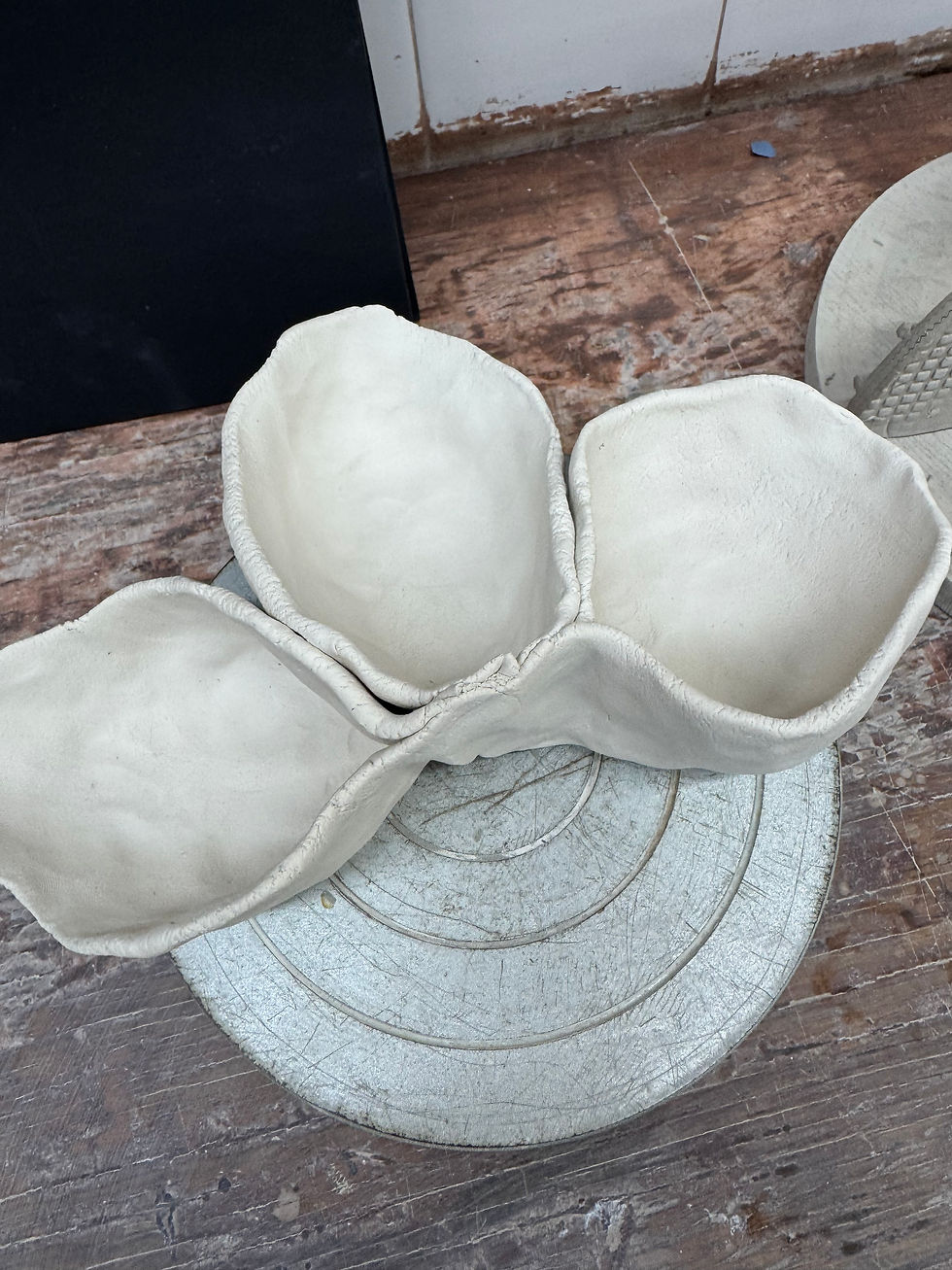
Using porcelain paper white clay, I made four simple pinch pot bowls and joined them together to form one interconnected piece. I created barnacle textures (as described in a previous blog post), tearing and attaching the patterned clay to each bowl. Most of the barnacle forms are positioned on the exterior, though I added a few on the inside too, giving the piece a more natural, encrusted, organic feel.
To complete the vessel, I added a few small spiral forms reminiscent of shells nested in the centre. The overall effect is something that feels grown rather than constructed.
With any luck, this natural vessel will balance on top of the windmill-inspired stand, allowing the two contrasting worlds to meet—one engineered, one organic.
Both pieces are still awaiting glazing, so the next stage will be seeing how surface and colour further define (or contrast) their identities. I’m excited and a little nervous to see how they evolve in the kiln.



Item 2 - A natural-world stand paired with a man-made vessel
The Natural-World Stand: Inspired by Trees
The stand began with the extruding session last week, where I experimented with tubing that naturally lent itself to tree-like forms. I extruded multiple round tubes and tore them off intentionally to create irregular, organic edges. From the selection, I chose four that were closest in height and allowed them to dry until they were just approaching leather-hard—firm enough to handle but still soft enough to carve.
Using a range of tools, I scored marks into the surface of each tube, varying both depth and direction. The goal was to mimic bark: rough in places, subtle in others, and irregular overall—just like real trees. I created small branch-like extensions in a similar way and attached them using the usual score-and-water method. The end result is a cluster of stylised tree trunks that feels rooted in the natural world.
The Man-Made Vessel: Inspired by Traffic Lights
In contrast, the vessel takes its inspiration from something far more industrial: traffic lights. I began by extruding a four-sided tube, and as it emerged from the extruder, I gently coaxed it into a horseshoe shape—a soft bend that gives the form a sense of movement while still maintaining its engineered character.
After allowing it to dry for a while, I cut six large circular holes into the top surface. These will eventually hold slices of peppers in red, yellow, and green—an echo of the colours of traffic lights but translated into food presentation. On the ends of the horseshoe, I added thin tubular extrusions to resemble torn-off wiring, reinforcing the idea of something man-made, mechanical, and slightly deconstructed.

I’m particularly looking forward to glazing the tree stand. I’m imagining a mix of browns and blacks layered together to bring out the carved textures and deepen the bark-like effect.
The vessel, however, is giving me more to think about. Should the top be glazed black, like the casing of a traffic light? Should the “wires” be brightly coloured? Or does that risk being too literal? I’m still weighing up whether subtlety or boldness will serve the form better. Sometimes the right glaze decisions only emerge when the bisque piece is in front of me—so I’ll let this puzzle simmer for a bit longer.


Comments