Inspiration

Inspirational photographs
These photographs, taken by me, serve as the inspiration behind the shapes, textures, and surface decorations of my ceramics. Drawing from the coast, my work seeks to look beyond the typical seaside aesthetic, focusing instead on the wider natural phenomenon of the salt marsh and estuary environment. This includes the geological nature of the mud and grasses along the river estuary where it meets the sea, the changing forms of the beach further along the coast, and the rich biodiversity of plants, birds, and insects that inhabit these shifting landscapes.


Forgotten vessel
This boat has been shifted countless times by the high tides, but now it’s so deeply wedged in the thick mud of a side channel that I doubt it will ever move again. Still, the power of the sea and nature never ceases to amaze me. There’s something deeply sad about seeing a boat that once sailed freely, now trapped and decaying, seemingly powerless and forgotten, left to the mercy of time and the elements.

Shifting boundaries
The interaction between the incoming tide, the rocks, and the surrounding muddy edges of the salt marsh creates fascinating movements and patterns. These natural rhythms and textures are something I’m keen to explore and reinterpret through surface texture and mark-making in my work.


Caught between land and tide
The discarded tyre is a stark reminder of the constant impact of human activity on the natural environment. Carried downstream by the river, it now sits temporarily caught among the mud and rocks. Yet, its curved form echoes the arcs found in nature, connecting visually with the sweeping tyre tracks left along the beach further down the coast.
Chorus of the marsh
The salt marsh provides a vital home and sanctuary for a wide variety of bird species. Standing at its edge, watching them arrive and depart while listening to the chorus of calls, feels like witnessing a natural performance unfold. It’s both beautiful and deeply calming, a quiet, ever-changing spectacle offered freely by the landscape.


Tidal palimpsest
On closer inspection, the beach reveals a rich layering of marks left by vehicles, people, and dogs—tracks overlapping and intertwining to record the passage of time since the last tide. With the return of the sea, these traces will be washed away, making space for a new set of impressions as the water recedes. It’s a quiet reminder of life’s rhythms and the constant possibility for renewal and fresh beginnings.
Between sea and sky
Gulls circle above the beach by the pier at Blackpool—graceful in motion, loud in presence, turning the sky into something restless and alive.
Noisy, watchful, and timeless—always returning, always there.


Fleeting lines
Left untouched by the tide for days, the estuary floor dries and fractures beneath the heat. Cracks spread into intricate, fleeting patterns—quietly beautiful, but never permanent.
Soon, the returning sea and steady pull of time will smooth them away, as if they were never there at all.
Break in the Storm
Rays of light break through heavy storm clouds, falling in angled beams onto a darkened beach below. The contrast between shadow and illumination is sharp, with the land and sea still holding the weight of the storm.
Out in the water, faint silhouettes of offshore wind turbines emerge where the light catches them. The beams briefly highlight their structures against the shifting grey sea, turning them into momentary points of focus within the wider weather.


Chasing the Shore
A dog runs freely along the edge of the sea at sunset, moving with clear joy and energy. Its body is caught mid-stride, close to the waterline where sand meets the incoming wash of waves.
As it moves, the spray from the surf lifts into the air, scattering in small droplets that catch the low sun. Each momentary burst of water briefly glows, suspended against the warm tones of the evening light before falling back to the shore.
Behind it, the sea stretches outward under a fading sky, calm in contrast to the movement in the foreground. The scene holds a sense of openness and release — motion, light, and tide all shifting together at the edge of day.
Evening tide marks
The setting sun gently highlights the softly formed ridges of sand left behind by the retreating tide, forming a irregular rhymic pattern along the vast expanse of beach, littered with empty razor clam shells


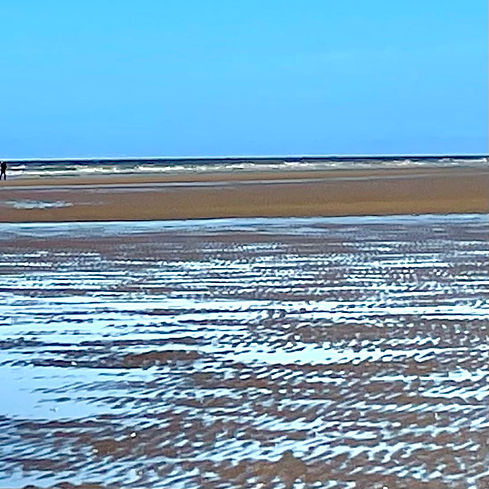
Shoreline layers
Stripes of sky, sea, sand, and water-covered sand ridges provide inspiration for both texture and colour, offering a natural layering of tones and surfaces that informs my work.

The end of the journey
The side of the abandoned boat is coated in layers of peeling paint, lifted and curled by salt, wind, and long exposure to the shore. Faded colours overlap and fracture, revealing older coats beneath — each one a record of time passing and care once given.
The surface is uneven and brittle in places, softened in others where weather has worn it down. Cracks run through the paint like fine lines of erosion, and small sections have fallen away entirely, exposing raw material beneath.


Weathered grace
Carried by tide and time, this gnarled tree has been stripped back to its essential form. What remains is shaped entirely by exposure — to water, salt, wind, and the slow work of erosion.
Its surface is worn smooth in places, fractured in others, each line tracing the long process of change rather than a single moment of loss.
Resting where it has been left, it feels like something held between movements of the marsh — neither beginning nor ending, but part of an ongoing passage shaped by time itself.

Shadow on the Salt Marsh
The evening shadow of a person and a dog is cast across the marsh floor. The human figure is caught mid-gesture, arm extended, pointing towards the river in the distance. The dog stands close by, its shape compressed into the same shifting outline of shadow and grass.
The river itself is a moving boundary, always arriving and leaving. The gesture feels like a moment of direction within something much larger and older, as if acknowledging the water’s passage rather than interrupting it.
Everything in the image belongs to transition: the marsh between tides, the light between hours, and the figures reduced to temporary marks on a surface that is constantly being rewritten.


Written in Mud
Wavy lines left by the retreating tide run across the salt marsh mud, briefly holding the shape of moving water. Over them, a scatter of bird footprints cuts in many directions — quick, overlapping paths across the exposed ground.
Nothing here lasts. The marks already belong to the next tide that will soften them, erase them, and return the surface to water and flow.

Edge of Flow
At the edge of the salt marsh, an overflow pipe ends abruptly, releasing water into a narrow creek that winds back toward the river. The flow is small but constant, cutting a clean line through the soft mud.
Nearby, an abandoned boat sits half-sunk, lodged in the marsh. Its hull is weathered and slowly breaking down, held in place by mud that is both soft and unyielding — giving way only in appearance. It no longer moves with the water; instead, it is held by it, fixed within the tidal ground.
Behind it, the river continues to flow freely, indifferent to what has been left behind. The scene holds a quiet contrast: movement and stillness, function and abandonment, water returning and water escaping — all meeting in the same shifting edge of the marsh.


Three Posts at Sunset
Three weather-worn wooden posts stand upright on the beach, spaced unevenly across the sand. Their surfaces are bleached and roughened by years of salt, wind, and shifting tides, each one marked by lines of exposure and time.
Behind them, the tide line curves gently across the shore, while the sea stretches out toward the horizon. At sunset, the light falls low and warm, catching on the worn grain of the wood and softening the edges of the scene.
They feel like remnants of something once functional, now reduced to markers of presence. Fixed in place, they hold their position against a landscape that is always moving around them — tide in, tide out, light fading into evening.

Silhouettes at Dusk
The pier stands in silhouette against the fading light, its structure darkened as sunset gives way to night. From the beach, the working pier appears as a solid line reaching out into the sea, its form still serving its purpose within the shifting horizon.
Further out, the remains of an older pier are just visible — broken stumps rising from the water, worn down by time and tide. As the light fades, the distinction between the two structures softens, both reduced to outlines against the darkening sky and sea.
There is a quiet contrast between presence and absence here: one pier still in use, the other left to the water. Yet as night falls, both become part of the same silhouette, held together by the shoreline and the fading light.


Mirrors of the Marsh
Pools of water left behind by the retreating tide sit perfectly still across the salt marsh, each one holding a flawless reflection of the sky above. The setting sun spreads soft pinks and purples across the clouds, mirrored with clarity in the quiet surfaces below.
Between the pools, the marsh is textured with grass, mud, and sand shaped by the tide’s withdrawal. The stillness of the water contrasts with the layered ground around it, creating small, separate windows of sky resting within the earth.
As the light deepens, the landscape feels suspended — the sky reflected below, the land exposed, and everything held in a brief moment of calm before the tide returns.

Coastal Anchor
A solid black, ancient anchor stands in silhouette on the coast against a vivid sunset sky. Its heavy, weathered form is still and grounded, sharply outlined by the fading light.
Behind it, the sky shifts through deep pinks, oranges and purples, while the salt marsh lies quiet below. Once used to hold ships in place, it now rests as a fixed presence against a constantly changing horizon.


Facing the Storm
A heavy, storm-filled sky gathers over the landscape, layered with dark, shifting clouds that suggest movement and pressure. The light is muted and uneven, giving the scene a sense of approaching change.
Below it, the windmill stands firmly in place, its structure exposed and unprotected against the open sky. It faces the weather directly, unmoving, its form defined by contrast with the storm above.
The scene holds a tension between force and endurance — the sky in motion, the windmill still within it — each framed by the other.
Footprints and Flow
The water flowing steadily along Swan Creek, bordered by mud banks patterned with the footprints of birds, creates a strong sense of continual movement as it hurries towards the main channel of the Mahan Drahan River. The surface of the creek appears constantly shifting and changing, carrying the eye through the landscape and deeper into the marsh.
Dividing the salt marsh into distinct areas and territories, Swan Creek is one of the larger creeks that cuts through the riverbank. Its winding course forms natural boundaries within the landscape, while the textured mud edges — marked by the traces of birdlife — reveal the constant interaction between water, wildlife and tide.
The scene feels both calm and active at once, shaped by the steady rhythm of the flowing water.


Monochrome Marsh
The endless natural expanse of the salt marsh contrasts sharply with the manmade structures visible in the distance — the windmill rising against the horizon and the angular forms of the street lights lining the path along the Green. Their rigid shapes interrupt the softness and irregularity of the marsh landscape, creating a visual tension between the natural and the constructed.
By adjusting the colours of the photograph to black, grey and white, the industrial quality of these forms becomes even more pronounced. Stripped of natural colour, the image feels graphic and architectural, with the strong contrasts emphasising line,
structure and silhouette.
The monochrome palette removes some of the softness of the landscape, allowing the manmade elements to dominate and giving the photograph a more stark and contemporary feel.
Remains of the Tide
Taken at ground level, the photograph captures the lingering remains of the tide and highlights the vegetation’s constant state of flux within the salt marsh environment. The plants exist in a continual cycle of change — saturated by seawater for a time, then exposed to air and sunlight, sometimes partially submerged and partially revealed as the tide shifts around them.
Small bubbles gather on the surface of the standing water, formed by trapped air, decaying organic matter and gases released from the marsh mud beneath. These delicate surface patterns are only temporary, existing briefly before the returning tide reclaims the pools or the warmth of the sun slowly evaporates them away.
The image emphasises the transient nature of the marsh landscape, where water, land and vegetation are in a constant process of transformation.


Between the Gaps
A rubber grid laid down to aid pedestrians approaching the front also creates an unexpected framework through which grass and weeds emerge and grow. Within each small section, fragments of vegetation are naturally framed, transforming an ordinary functional surface into something patterned and organic.
Only the hardiest plants survive here, enduring the continual onslaught of passing feet and dogs, alongside rain, wind and harsh sunlight. Yet the grid is also shared with the quieter activity of the marsh environment — hedgehogs passing through, birds searching for food, and insects moving unnoticed between the growth.
Despite these constant pressures, the vegetation not only survives but continues to thrive

The Changing Edge
This black and white representation of the grasses and wild flowers growing along the edge of the marsh highlights the rich variety of forms, textures and structures found within the landscape. Without the distraction of colour, the intricate shapes of stems, seed heads and petals become more pronounced, creating an image that feels both delicate and graphic.
As spring progresses, this collection of plant life is constantly changing. Each visit to the marsh reveals new growth, unexpected combinations and small seasonal transformations. What may appear sparse one week quickly becomes layered and abundant the next, making the landscape feel alive with continual quiet change and discovery.
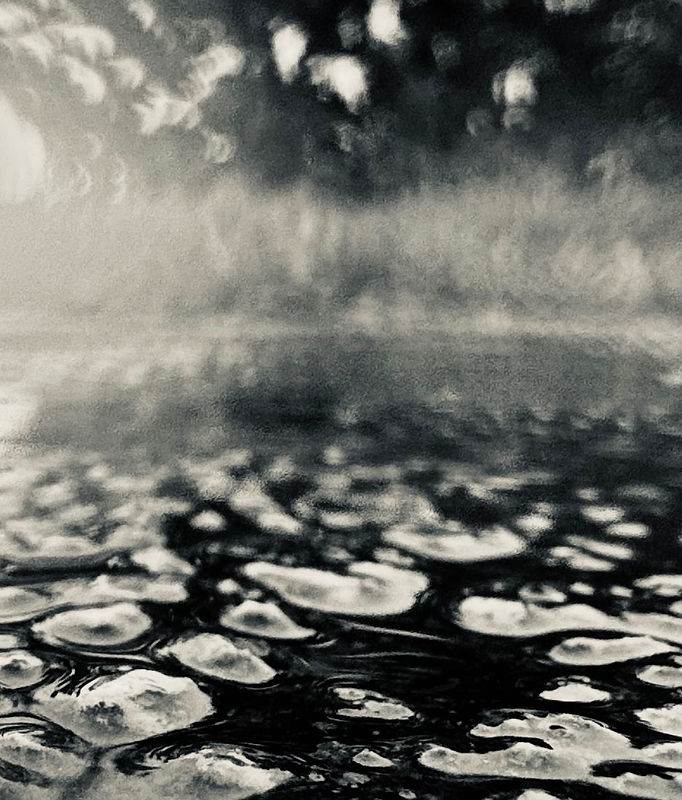

Rain Patterns
An attempt to capture the rain falling on the tarmac path beside the marsh shows heavy droplets hitting the already partially flooded surface. Each drop creates small ripples and shifting patterns as water collects and moves across the path.
The result is a simple but constantly changing surface, where rain and standing water interact to form brief, unexpected patterns along the edge of the marsh.
Long Shadows at Dusk
An elongated shadow moves across the newly cut grass, briefly borrowing the shape of a person and their dog before dissolving again into the evening light. In this low sun, form becomes fleeting and weightless — a passing imprint rather than a fixed presence. Beyond, the marsh hums with settling birds, but here the focus is transient: shadow stretching, thinning, and vanishing as the day slips away.


A Tale of Two Trees
On the left stands a tree in the fullness of life—lush, green and vibrant, its branches alive with birds and dense foliage. In contrast, on the right is the weathered remains of a tree washed ashore by the tide, its trunk held upright by driftwood in a poignant imitation of life. Together they speak of the contrasting stages of nature's cycle, reminding us that growth, decline and renewal are all part of the same continuous journey.