Exploring the Effects of Oxides and Underglazes on Porcelain Paperclay
- Victoria
- Nov 14, 2025
- 2 min read
Porcelain paperclay offers ceramic artists a unique blend of strength and versatility, making it a popular choice for both sculptural and functional work. One of the most exciting aspects of working with porcelain paperclay is experimenting with surface decoration, especially using oxides and underglazes. These materials can dramatically change the final appearance of a piece, but their behavior on porcelain paperclay can be unpredictable.
I decided to decorate the majority of the porcelain paperclip pieces I’ve made using a variety of oxides and underglazes, allowing me to explore subtle variations in surface and color. Two pieces were intentionally left plain and dipped only in a transparent glaze to act as a control, providing a clear comparison between decorated and undecorated surfaces.
Pieces One and Two - Small bowls
Both dipped in transparent glaze only. Extremely pleased with this effect.


Piece Three - Barnacle sample 1
Copper Carbonate with sponge x 2, plus transparent. Very happy with this effect, the oxide has combined beautifully with the surface texture, I think the sponging technique worked well.


Piece Four - Barnacle sample 2
Cobalt plus white. This is a lovely colour but I would have preferred it somewhat lighter. I am unsure how much cobalt I applied, it might work better applied with a sponge instead of a brush.


Pieces Five and Six - Small vessels
Black porcelain clay with iron oxide (black) applied to lower parts plus transparent. Delighted with these, the oxide parts are subtle but beautiful.


Piece Seven - Tiny vase
Copper Oxide on lower half plus transparent. This is far too dark, I think next time it would be better to use a wash.

Piece Eight - Coral
Three different oxides applied to the tubular forms, copper oxide (black unfired), copper carbonate (green unfired) and cobalt carbonate (brown unfired). I am very disappointed with the results of this as the tubular parts are consideably darker than I hoped, they are also patchy, too matt and the oxides have moved to parts that I wanted to remain white.


Piece Nine - Barnacle sample 3
I applied three oxides in a patchwork style, the oxides used were iron oxide yellow, iron oxide red and iron oxide black. Transparent glaze was applied on top. I am very happy with the results, it looks extremely organic and tactile.


Piece Ten - Small vase
Bright red underglaze plus transparent. I left the inside clear and the contrast between the white and the bright red is very pleasing. I am not sure how much I like the bright red but I am very happy with the results of this experiment. It would be interesting to try again but maybe apply with a sponge.


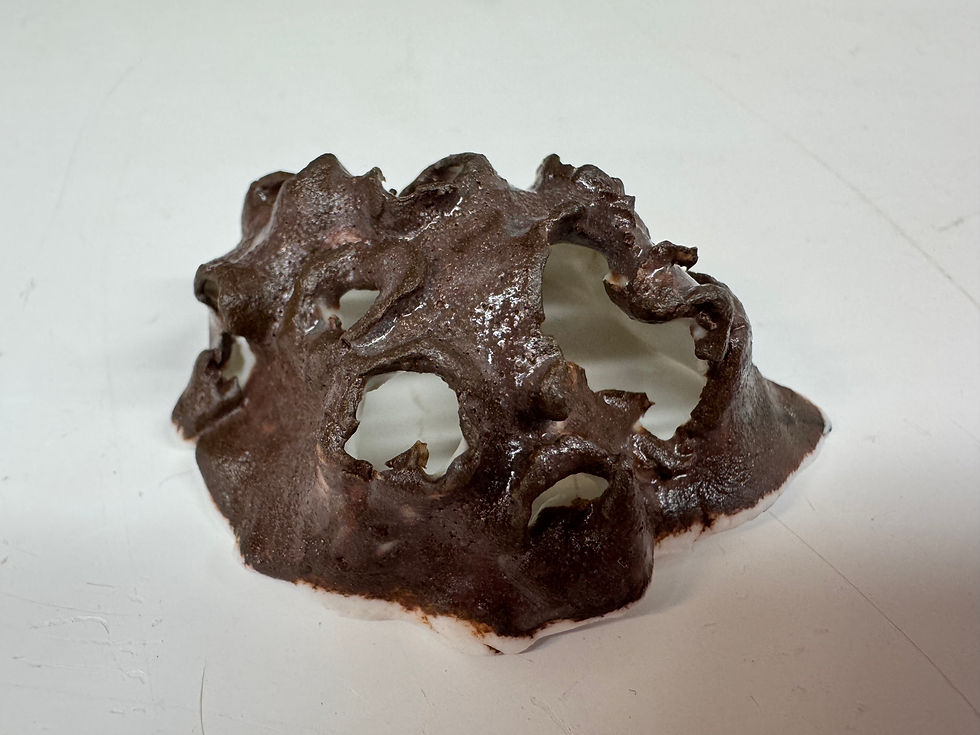
Piece Eleven - Very small barnacle sample 4
Walnut brown underglaze plus transparent. This is not very exciting and quite disappointing.


Comments