Contemporary Ceramics Gallery - Part One
I recently visited the Contemporary Ceramics Gallery opposite the British Museum. It’s a relatively small space, but packed with work by a wide range of contemporary ceramic artists.
Despite its size, the quality and variety of work is impressive. Each artist brings a distinct approach to form, surface and technique, and together the collection offers a broad snapshot of current directions in ceramics.
Below I’ve included the artists and pieces that most strongly resonated with my current work, as well as those that pushed me to think in new directions. Some connect closely with ideas I’m already exploring, while others open up completely different possibilities.

Miae Kim
One of the first artists that stood out to me was Miae Kim. Her work combines a graphic sensibility with traditional ceramic techniques, resulting in surfaces that feel both precise and layered.
She typically hand-builds her forms and develops highly considered decorative surfaces using a mix of methods such as inlay, terra sigillata, tape resist, and hand-carved drawing. These techniques are built up in combination rather than used in isolation, creating complex but carefully balanced compositions across the surface.
What interests me is how controlled and structured the decoration feels, while still retaining a sense of energy and depth. The surfaces are detailed, but not chaotic—each layer seems to respond to the ones beneath it.
This connects with my own interest in building surfaces through repeated processes and combining different mark-making techniques. It also reinforces the idea that traditional methods can be pushed further when they are layered and combined in unexpected ways.
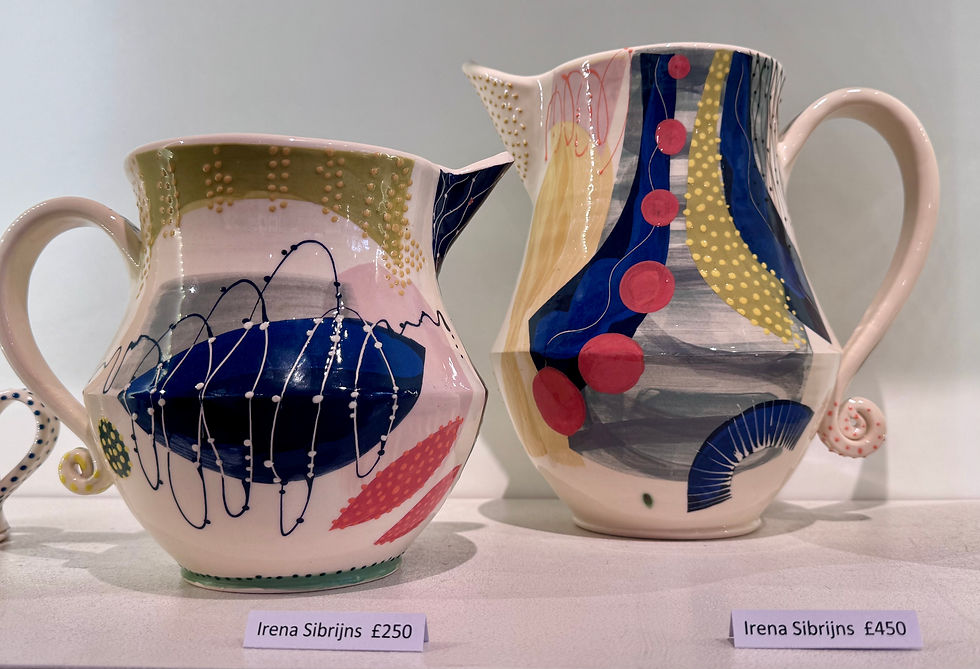
Irena Sibrijns
Another artist that stood out was Irena Sibrijns. Her work is influenced by Dutch painting traditions, reflecting the visual language and compositional sensibilities she grew up with in Holland.
The surfaces appear to be built up through carefully considered layers, mainly of glaze and possibly slip. There is a strong sense of depth created through the repeated application of multiple colours over one another. Across her work, certain motifs and pattern structures can be seen repeating
This approach made me think about how layering in ceramics can be used not just for colour development, but also as a way of building rhythm and continuity across a body of work.
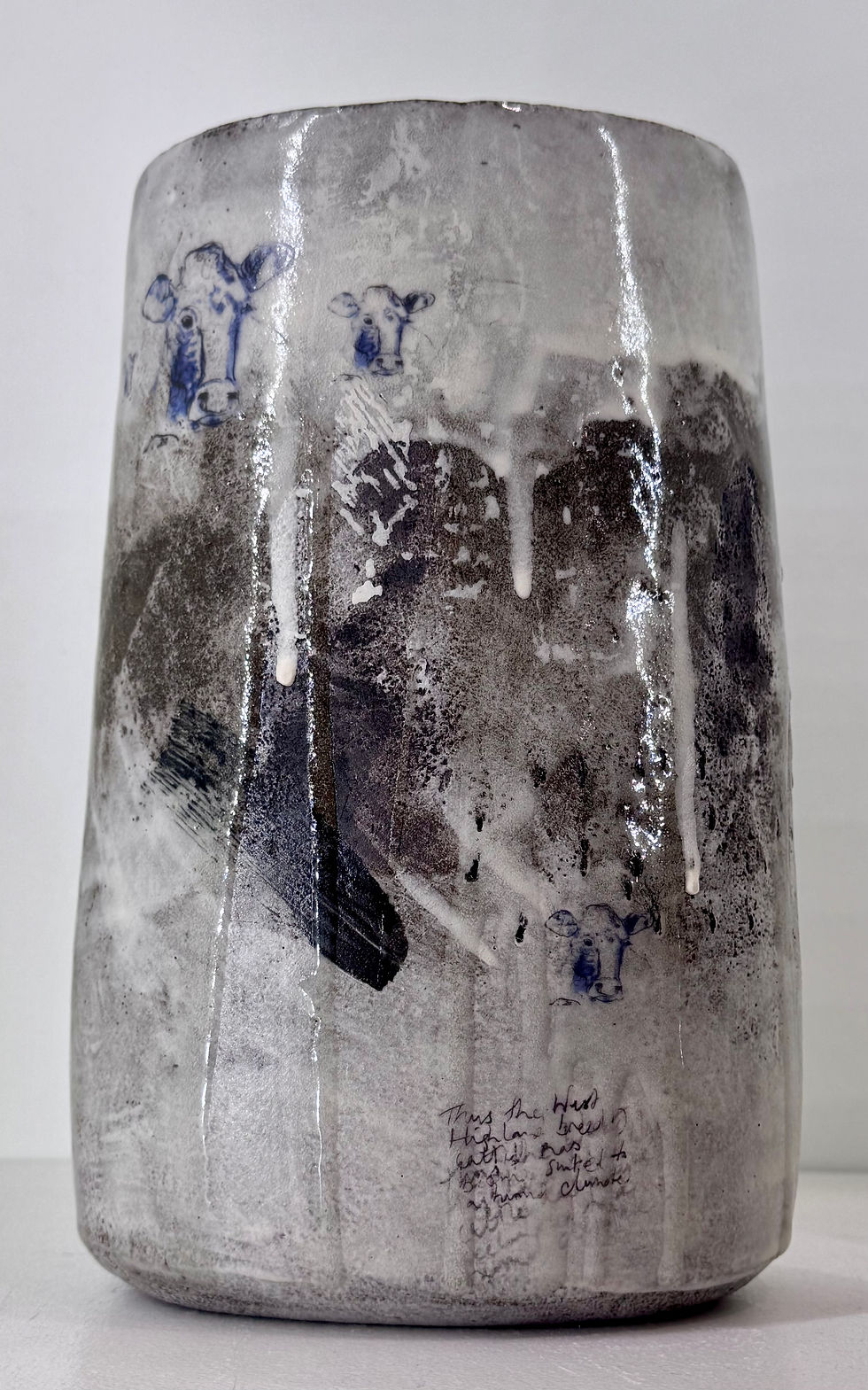
Fiona Thompson
Another artist that stood out was Fiona Thompson. Her practice combines traditional and contemporary ceramic processes, with a strong emphasis on surface and print-based decoration.
She hand-builds her forms and develops the surface through a mix of painting and printing with coloured slips. Alongside this, she incorporates lino printing and monoprinting techniques, transferring graphic marks onto the clay surface.
In addition to these processes, she uses underglaze pencils and oxides to build up drawn detail, and incorporates decals developed from her own drawings and photographs. These different approaches are combined rather than used separately, resulting in surfaces that feel densely constructed but still coherent.
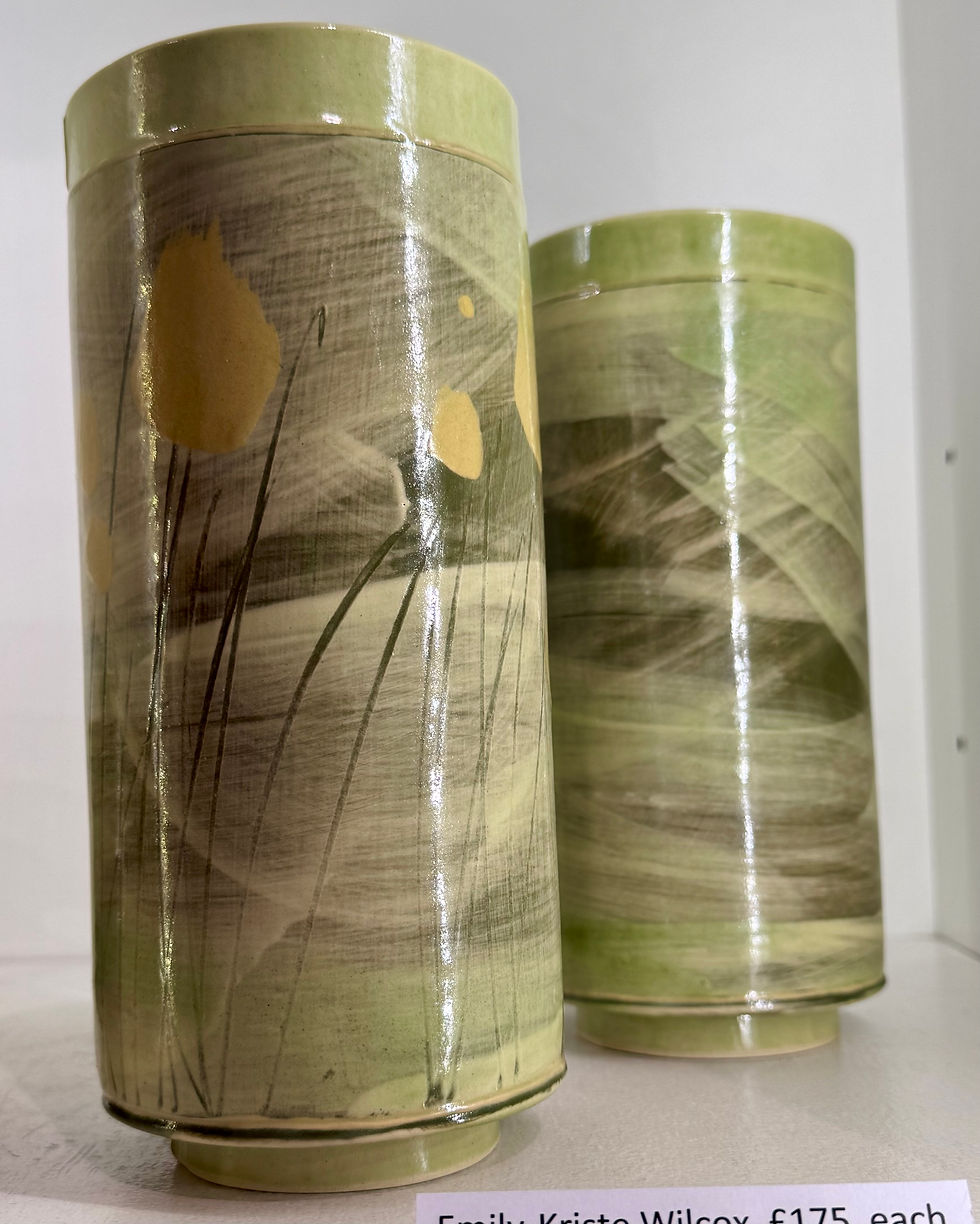
Emily-Kriste Wilcox
Another artist that stood out was Emily-Kriste Wilcox. I was particularly drawn to her use of layered slips and colour, building surfaces that are then cut back through sgraffito to reveal darker tones beneath, often a deep green layer.
This technique is used to create flowing linear forms, particularly in the depiction of plant-like stems and organic movement. These marks feel loose and natural, but the control required to achieve that sense of fluidity is clearly very high. The process is deceptively difficult—what reads as effortless drawing on the surface is in fact the result of careful timing, pressure and an understanding of how the slip layers will respond once cut back.
Her work also reminded me of the seagrass marks I use in my own pieces, where similar gestures are used to suggest movement and growth. There is a shared interest in letting a tool drag through a softer surface to create lines that feel both controlled and accidental.

Anna Lambert
I have been a long-time admirer of Anna Lambert, particularly after attending a talk she gave about her work. Her practice combines a range of construction and surface techniques, beginning with hand-built forms made from a white earthenware and grogged clay mix. She works with both soft and firm slabs.
Her work is frequently developed from drawing in the landscape, which acts as a starting point for both form and surface. Once constructed, the vessels are painted with multiple layers of coloured slips, often over a darker underlayer. These surfaces are then altered through cutting back, sgraffito and the use of hand-cut tissue paper stencils and masks, creating areas of contrast between revealed and concealed layers.
Conceptually, her work reflects an engagement with local landscapes and environmental change, including themes such as climate change and orchard regeneration. Rather than a purely representational approach, she draws on landscape as a way of thinking through surface, form and narrative within the vessel.
This feels closely connected to my own work, which is rooted in a strong sense of place. The salt marsh where I live continues to be a constant reference point—its shifting light, textures and colours informing how I think about surface, layering and form. Like Lambert, I’m interested in how landscape can be carried into the making process without becoming literal representation.


Comments