Box of Secrets - 1 - research
- Victoria
- Jan 16
- 3 min read
Updated: Feb 9
This project explores the relationship between a precious artefact and the vessel designed to protect and present it. The aim is to identify a meaningful or valued object and create a ceramic lidded box or container specifically to house it. The container should be thoughtfully designed, considering both function and symbolism, while pushing creative boundaries through experimentation and idea development.
A wide range of design concepts will be explored through sketching, modelling, and surface testing. Particular attention will be given to decorative and textural embellishments, using pattern, relief, carving, or applied elements to enhance the tactile and visual quality of the piece. The lid will feature a knob or finial, which should be intentionally designed as an integral part of the overall form rather than a purely functional addition.
The final box may subtly or directly reflect the nature of its contents through shape, texture, symbolism, or surface decoration. This connection between object and container encourages storytelling and personal expression, transforming the box into more than just a vessel—it becomes a meaningful artefact in its own right.
Through this project, the focus is on craftsmanship, conceptual thinking, and creative risk-taking, resulting in a unique ceramic piece that celebrates both the precious object within and the artistry of the container itself.
First Attempt
For my first attempt, I chose to create a ceramic box inspired by a mountain landscape, designed to hold a souvenir from my first ski trip. Skiing is a strong family tradition for me and is closely connected to memories of happy times spent with my parents, brother, husband, children, and friends. I wanted the box to capture both the emotional value of the object it contains and the sense of place associated with those memories.
To emphasise this concept, I decided to use two contrasting types of clay. The lower half of the box is made from stoneware, heavily textured using rocks to represent the rugged, solid base of a mountain. In contrast, the upper half is created from porcelain paperclay, chosen for its smoothness and whiteness to suggest snow-covered peaks. This contrast highlights the different qualities of the landscape while also creating visual and tactile interest.
The overall idea was inspired by the 1980s Ice Magic dessert container, particularly the way it visually separated layers and revealed a clear distinction between textures. This influence helped inform the structure of the box while allowing me to reinterpret it in a more personal and sculptural ceramic form.
Method and Construction
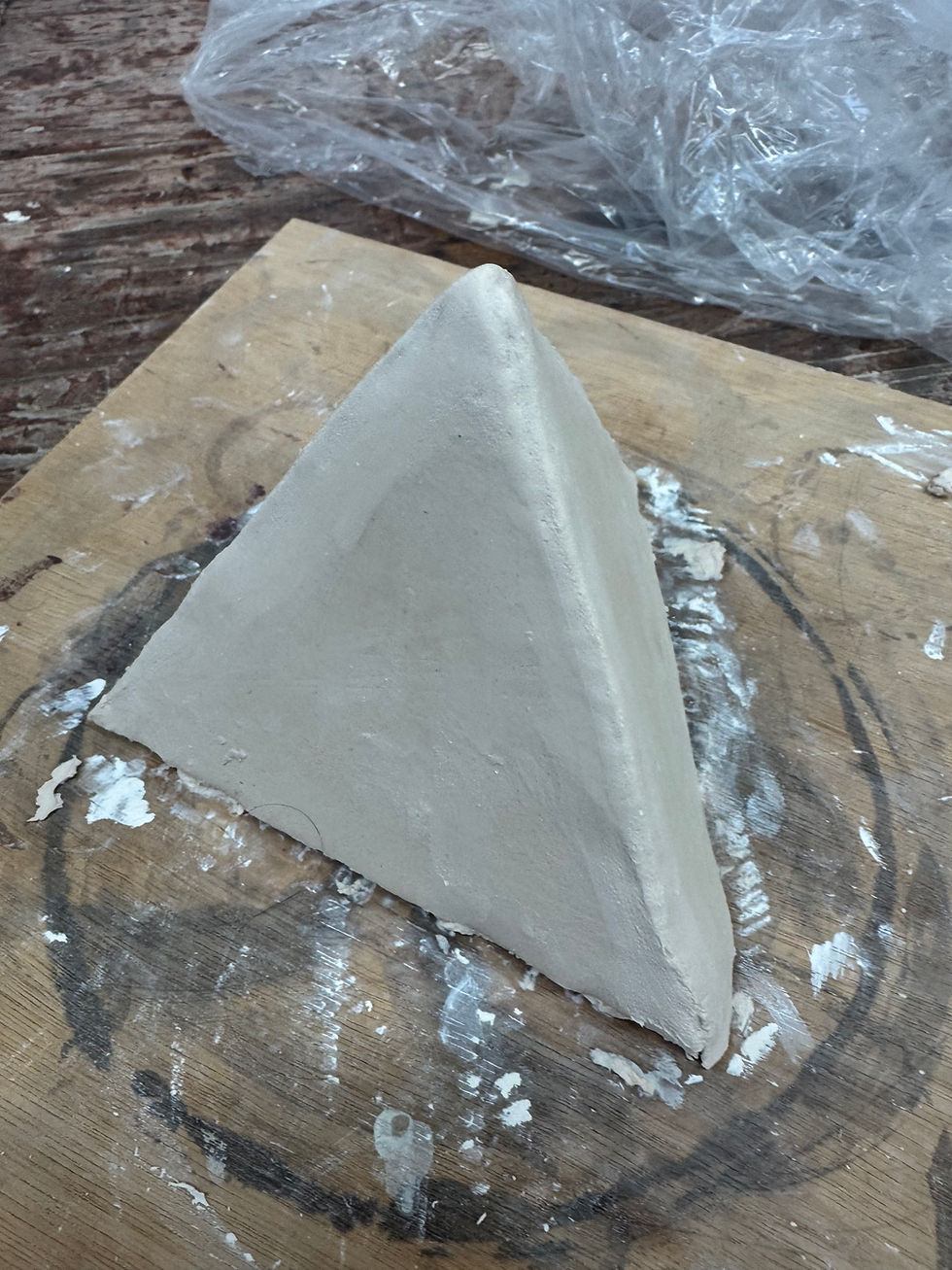
To begin, I rolled out two clay slabs: one in stoneware and one in porcelain paperclay. Both slabs were left to rest for a few hours to relax and firm up before cutting. I then drew and carved four triangles measuring 14 cm from the stoneware slab and four triangles measuring 15 cm from the porcelain paperclay. The larger size of the porcelain pieces was intentional, as I am aware that porcelain shrinks more during drying and firing. Once cut, all triangles were wrapped in plastic and left to rest for several days to reach an even working consistency.
Construction proved challenging, particularly when cutting the correct angles along the edges of the triangles. The angles needed to be less steep than the standard 45 degrees typically used for pyramid forms. Despite this difficulty, both pyramids were constructed successfully, and I was very pleased with the overall outcome at this stage.
The next challenge was transforming the stoneware pyramid into a functional container. I carefully removed the top section and carved away parts of the internal walls to create sufficient internal space for the object it is intended to hold. This process required patience to maintain the structural integrity of the form while increasing its capacity.
For the porcelain pyramid, I drew a jagged line around the halfway point and cut along it to create the impression of a snow-covered mountain peak. This irregular edge added visual interest and reinforced the landscape concept. Further carving was needed to reduce excess clay and refine the form.


Results
Visually, the result was very successful and closely matched my original intention.
However, two significant concerns emerged during this stage:
The stoneware clay repeatedly contaminated the porcelain, resulting in a muddy appearance, which is the opposite of the clean, snow-like surface I was aiming for.
Despite compensating for shrinkage, I am concerned that after firing the porcelain lid may still be too small to fit securely onto the stoneware base.
These issues will inform adjustments and problem-solving in future iterations of the design.
I will also consider the use of a different clay for the base to emphasis the contrast, possibly a more heavily grogged clay and/or a clay of a different colour.


Comments