Exploring the Interplay of Manmade, Nature, and Emotion in Project 1
- Victoria
- Oct 9, 2025
- 3 min read
As I begin this process, I am aware of how much I have to learn. Or rather, I am aware that I do not yet know what I don’t know, but I suspect that it is considerable. This challenge involved making 15 tiles, 5 representing each of the above mentioned categories. I was interested to see which would resonate most with my current practice. Almost immediately, I found myself drawn to the manmade-inspired tiles. There is something reassuring about their repetitive structures, the precision of pattern and the symmetry that made me feel an element of control. This led me to wonder if I prefer a process with “a set of rules” and conclude that it is going to be important for me to relax this need for control if I wish to develop as an artist.
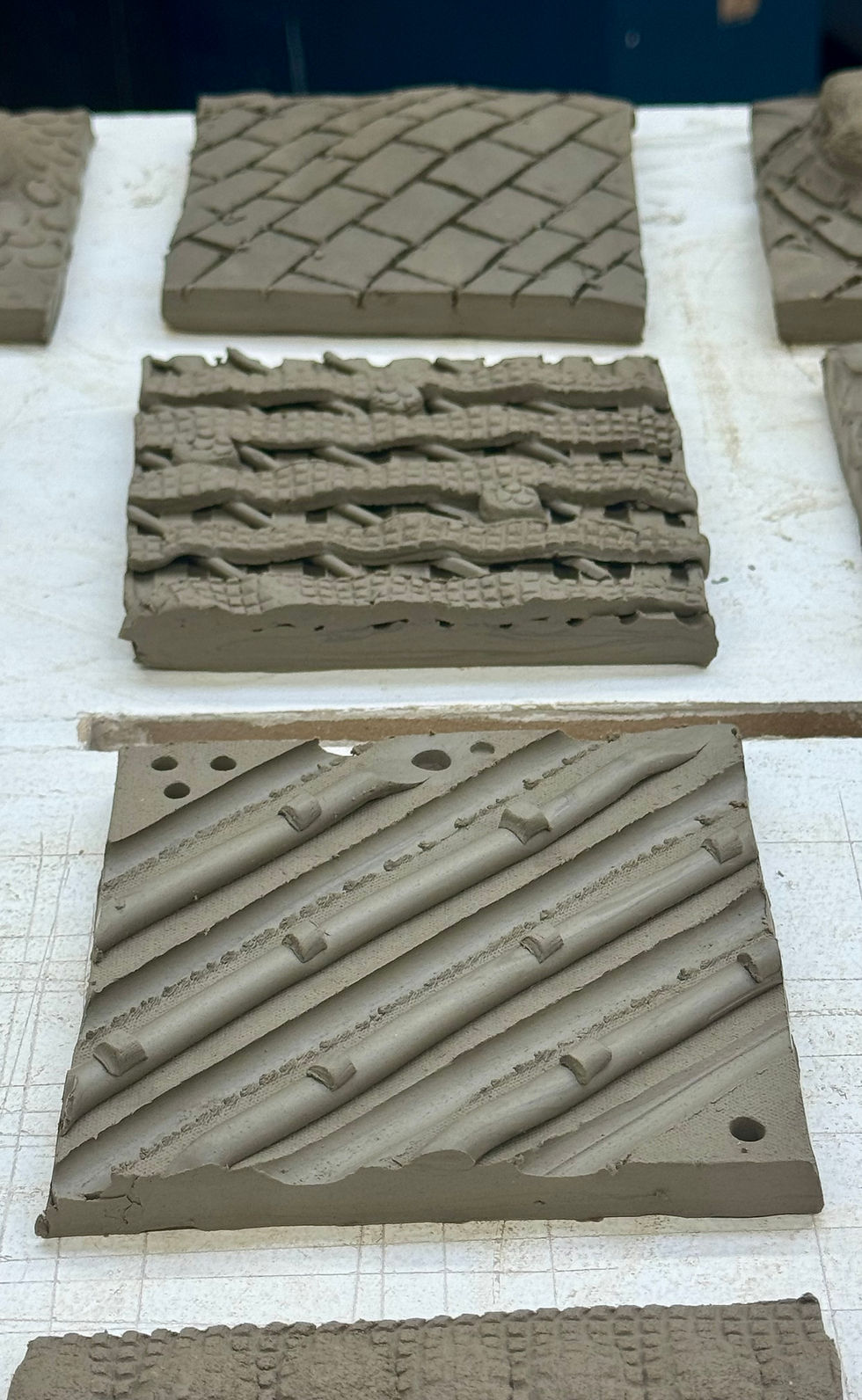
Manmade tiles
For my first manmade tile, I imprinted a grid design and then pressed it face down into a large sponge, using the reverse end of a tool to create a strict, rhythmic pattern (seven by six). The second tile explored a more sculptural approach. I removed sections of clay and reinserted them diagonally, creating contrasting planes and subtle variations in height. I particularly enjoyed how these shifts in surface produced shadows and I am hoping that the glazing will exaggerate this further.
The third tile also pursued the idea of removal and replacement by incorporating fragments from earlier works, introducing a sense of recycling and reconfiguration. For the fourth tile, I experimented with heat by applying a heat gun to parcially dry the surface before slashing it diagonally to create the impression of brickwork. Further heating encouraged the sides of the individual bricks to lift away.
The fifth tile was more minimal, I used a needle tool and a peach stone to draw a 3 dimensional box from a separate piece of clay. After halving its thickness I reattached it to the main tile with slip. For all of the above tiles, I started with a clear plan and I executed the plan exactly which I found to be satisfying.

Nature tiles
To my surprise, the nature inspired tiles were far more enjoyable than I had anticipated. My first tile was influenced by the work of Sue Dunne, and I used twigs and pine needles collected from outside the studio. After rolling them into the clay, I carefully removed them with the needle tool, leaving delicate imprints behind. I then explored creating bark-like textures by slicing into the surface - next time I plan to use a thicker slab to allow for greater stretching and more pronounced fissures.

The third tile focused on wave-like forms produced by scooping out sections of clay. I was not happy with this result, it felt very forced.

The fourth tile drew inspiration from Saturn with its rings reimagined as concentric bobbles which were impressed into the clay using the large sponge.

The final tile in this series was the most intricate. I carved into the clay with a variety of tools and then folded the clay back on itself to create curling waves, with the peach stone used to add texture and create a sense of motion.
These tiles had a rough plan to start with but were led primarily by trying out a mark making method and then assessing what might be interesting to do next. Once the process was under way, I enjoyed having options.
Emotion tiles
The first emotion was very definitely frustration, I used the edge of a rule and other sharp implements to disrupt and agitate the surface of the tile. The second tile was a combination of many different techniques, leaf imprints, multiple grid imprints and sponge impressions, representing confusion.
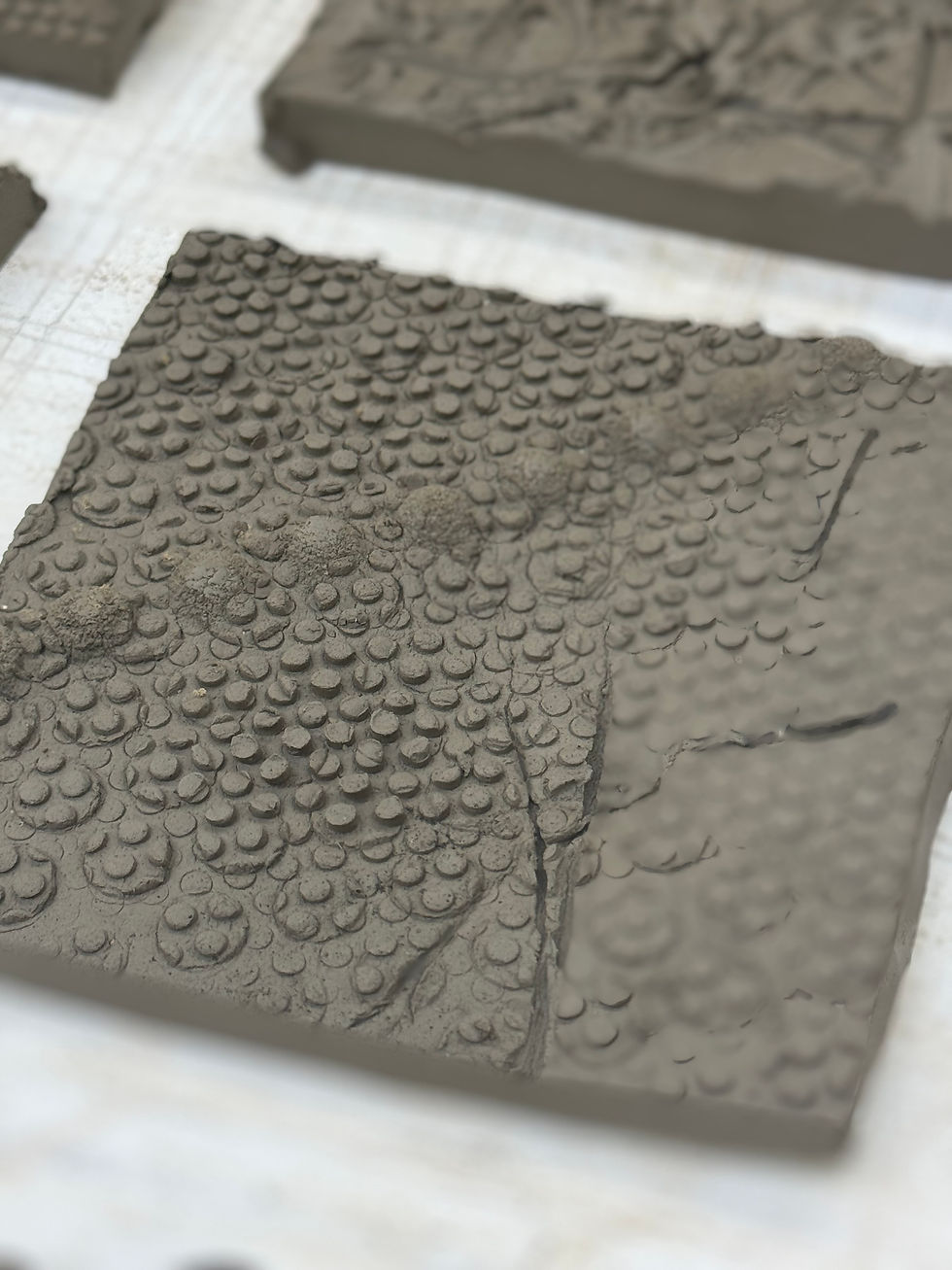
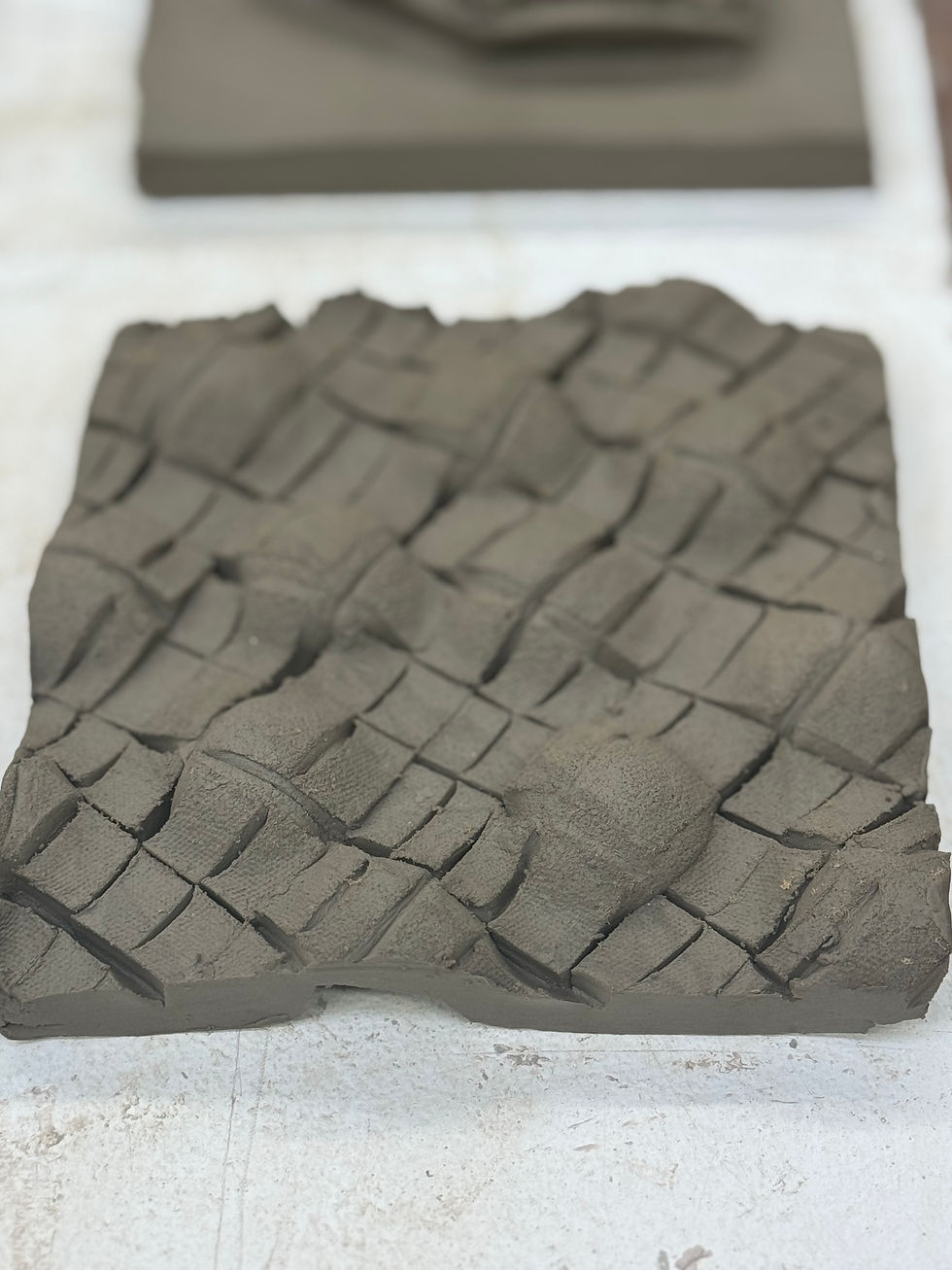
The third tile selected chaos but ultimately release, it was sliced diagonally in both directions and then physically slapped against the table top to encourage separation. Onto this fractured surface, I added rolled forms representing roses. So a meeting of gentleness and violence. The fourth tile is a representation of the Lake District using offcuts to create the bridge and river, with a base of grid impressions and sponge indentations. This would represent the emotion of happiness and tranquility.

The final tile was controlled slicing, again diagonal cuts but this time the separation was controlled through the use of a sponge with slow, careful reverse impressions, representing the introduction of emotion into the creative process but still very much feeling the need for control.


Comments